Wedding invitation wording follows a simple structure: a host line, a request line, the couple’s names, the date, time, and place, and a reception line, and this guide from Greenvelope’s stationery team pairs formal, casual, and modern wording for every line with more than 70 copy-ready examples, from black-tie cathedral to backyard barbecue.
Those few lines tell guests how formal the day will be, who is hosting, and what kind of celebration to expect, all before anyone reads a single detail. The conventions are simpler than they look, and every variation follows the same structure, so this guide walks through each line, assembles the pieces at every level of formality, and then covers the situations couples second-guess most: divorced parents, second marriages, adults-only receptions, elopements, and changed dates.
The words are only half of the invitation; the other half is how they arrive. Greenvelope is a digital invitation platform built for exactly this pairing: its digital wedding invitations combine customizable designs from independent artists with an animated envelope reveal and built-in RSVP tracking, so the wording you settle on below arrives with the presentation it deserves.
At a Glance
- The building blocks every wedding invitation shares, laid out slot by slot in a copyable table
- Formal and modern wording side by side for the request line, date, time, and hosts
- Host line wording for every family situation, including divorced parents and a deceased parent written out in full
- More than 70 copy-ready examples across formal, casual, modern, romantic, lighthearted, and themed registers, many paired with finished invitation designs and their artists
- Wording for the hard cases: second marriages, vow renewals, elopements, adults-only receptions, postponements, destination weddings, and bilingual invitations
- Text message and email wording, a mix-and-match line bank, timing rules, and the wording mistakes couples make most
What Do You Write on a Wedding Invitation?
Almost every wedding invitation, whatever its style and whether it is printed or sent as a Greenvelope digital invitation, is built from the same slots. Get these right and the wording falls into place; everything after this table is variations on it.
| Slot |
What it does |
Example line |
| Host line |
Names whoever is extending the invitation |
Mr. and Mrs. James Rivera |
| Request line |
The invitation itself, and the first signal of formality |
request the pleasure of your company |
| Couple’s names |
The stars of the day, on the most prominent lines |
Sofia Anne Rivera and Daniel Marcus Cole |
| Date and time |
Spelled out formally or written plainly |
Saturday, June 12, 2027, at 4:30 in the afternoon |
| Location |
Venue name with city and state beneath it |
The Foundry, Seattle, Washington |
| Reception line |
What follows the ceremony, and where |
Dinner, drinks, and dancing to follow |
| Details and RSVP |
Dress code, reply deadline, and the wedding website |
Kindly RSVP by May 16 at [yourwebsite.com] |
Formal vs. Modern Wording
The biggest decision is tone, and this side by side is how Greenvelope pairs the two registers: formal wording spells everything out and stays in the third person; modern wording is warmer and can use numerals and first names.
| Part |
Formal |
Modern |
| Request line |
request the pleasure of your company |
would love for you to join them |
| Date |
Saturday, the twelfth of June |
Saturday, June 12, 2027 |
| Time |
at half after four o’clock |
at 4:30 in the afternoon |
| Hosts |
Mr. and Mrs. John Smith |
Together with their families |
The Request Line: Honour, Pleasure, or Something Warmer
Greenvelope’s stationery team teaches one old convention before any other. “Request the honour of your presence” (traditionally with the British spelling) signals a ceremony in a house of worship, while “request the pleasure of your company” is the formal choice for a secular venue. Neither is required, but if you use one, use the right one; the guests who know the difference will notice.
Beyond those two, the request line is yours to soften as far as the day calls for: “invite you to celebrate their marriage,” “would love for you to join them,” or simply “are getting married, and you are invited.” The only rule is that the register should match the rest of the invitation, and the mix-and-match line bank further down collects a dozen request lines from most formal to least.
Who Hosts? Handling the Host Line
Greenvelope’s stationery team frames the host line this way: it has loosened up a lot, there is no longer a single “correct” version, so pick the one that reflects who is celebrating and, if relevant, who is contributing.
- One set of parents hosting: “Mr. and Mrs. James Rivera request the honor of your presence…”
- Both families hosting: “Together with their families…”
- Both sets of parents named: “Mr. and Mrs. James Rivera and Dr. and Mrs. Anthony Cole invite you to the marriage of their children…”
- Divorced parents hosting together: list each parent on their own line with no “and” joining them, traditionally with the mother’s name first: “Dr. Elena Marsh” on one line, “Mr. James Rivera” on the next. If a parent is hosting with a new spouse, list that couple together on one line.
- Honoring a deceased parent: a late parent is remembered beside the couple’s name rather than as a host, since the host line implies an invitation being extended: “Sofia Rivera, daughter of James Rivera and the late Maria Rivera.”
- The couple hosting: “Ava Chen and Marcus Reid invite you to celebrate their marriage…”
Every format above works for any couple. For two brides, two grooms, or any couple at all, the conventions are identical; put the names in whatever order the couple prefers, and let alphabetical order settle any tie.
Here is how the host and request lines sound together, across four common configurations:
Mr. and Mrs. Gutierrez
request the pleasure of your company
at the marriage of their daughter
Mr. and Mrs. Kim together with Mr. and Mrs. Adjemian
request the honor of your presence
at the wedding of their children
Together with their families, Kendrick and Kayla
invite you to join them
for their wedding day
Frank and David
joyfully welcome you to attend
the celebration of their love
Divorced Parents, Written Out
The divorced-parents version is the one couples second-guess most, so here it is in full:
Mrs. Linda Reyes
Mr. Daniel Reyes
request the pleasure of your company
at the marriage of their daughter
Isabel Reyes
to
Liam Walsh
Saturday, the ninth of October, two thousand twenty-seven
at five o’clock in the evening
Reception to follow
Honoring a Deceased Parent, Written Out
When a parent has passed, the memory belongs beside the couple’s names, and the wording reads naturally once you see it assembled:
Mr. James Rivera
requests the honour of your presence
at the marriage of his daughter
Sofia Anne Rivera
daughter of the late Maria Rivera
to
Daniel Marcus Cole
Saturday, the twelfth of June, two thousand twenty-seven
at half after four o’clock
Reception to follow
The Couple’s Names
On a Greenvelope invitation or a printed one alike, if the couple’s names are not already in the host line, give them the most prominent spot on the card; it is impossible to have a wedding invitation without knowing who is getting married. Full names, including middle names, are traditional, though first names alone are now common even on formal invitations. Convention places the bride’s name first, followed by the groom’s, but list yourselves in whichever order sounds like you; many couples simply use the order they say their names in.
Date, Time, and Location on the Invitation
After the host and request lines and the couple’s names come the date, time, and place, and Greenvelope’s stationery team applies one register rule to all three. Formal invitations spell the date and time out in full (Saturday, the fifth of June, two thousand twenty-seven, at half after four o’clock), while casual invitations can use numerals; the table above shows the two registers side by side. The venue name sits on its own line directly below the time, with the city and state beneath it, and the full street address can live on the invitation or on your wedding website so guests can plan transportation and parking. Give the reception its own line even if it is as simple as “Reception to follow,” and name the second venue if the celebration moves.
Dress Code
Tell guests what to wear before they have to ask, which on a Greenvelope invitation is a single editable line near the bottom of the card: “Black tie optional” or “Cocktail attire” does the trick, and themed celebrations can spell it out further, whether that is a gothic wedding or a Great Gatsby evening. For the full decoder, from white tie to festive attire, see our guide to wedding dress codes; and if black tie is the answer, the dedicated section further down covers how the rest of the wording should follow.
The Reception Line and the RSVP
Greenvelope’s wording rule for the reception line is one line, not a paragraph. If the celebration continues at the ceremony venue, “Reception to follow” is enough for formal invitations, or something with more personality, such as “Dinner, drinks, and dancing to follow,” for modern ones. If the reception is elsewhere, add the venue and, for paper, a separate reception card; a digital invitation simply carries the second address and a map link on the same card.
The RSVP line needs a deadline and a method. “Kindly reply by the sixteenth of May” suits a formal invitation; “RSVP online by May 16” suits a modern one. Set the deadline three to four weeks before the wedding, and the timing guide covers the full schedule around it. This is also where format quietly matters: with Greenvelope, the RSVP is built into the invitation itself, so guests reply in the same moment they open it, and hosts watch responses, meal choices, and plus-one counts collect in real time instead of chasing response cards. The full mechanics, from reply deadlines to headcounts, live in our guide to collecting RSVPs online.
Wedding Invitation Wording Examples With Online RSVP
Most couples now collect replies online, and a Greenvelope invitation needs only one well-made line to carry it: where to reply, and by when. What trips couples up is register. “Visit our website” can read like an errand on a formal card, so match the RSVP line to the invitation around it rather than defaulting to the phrasing everyone uses. A few that work, from most formal to least:
- “The favor of a reply is requested by the sixteenth of May at [yourwebsite.com]”
- “Kindly reply at [yourwebsite.com] by May 16”
- “Please RSVP online by May 16 at [yourwebsite.com]”
- “RSVP by May 16: [yourwebsite.com]”
- “Let us know by May 16 at [yourwebsite.com]”
How to Ask Guests to RSVP Online on a Wedding Invitation
Three elements make an online RSVP request work for every guest. State the deadline, give the address exactly as it should be typed, and place the line where eyes finish, at the bottom of the invitation. If the guest list spans generations, add a graceful alternative so nobody is stranded: “or reply to Maria at (503) 555-0114.” A digital invitation removes the typing problem entirely; with Greenvelope, the reply button lives inside the invitation, so there is no address to retype and nothing to look up.
Wording for Online-RSVP-Only Invitations
If there are no response cards at all, say so plainly. Traditional guests will wait politely for a card that is not coming unless the invitation tells them otherwise, and clear beats clever here. These three lines from Greenvelope say it plainly:
- “We are collecting all RSVPs online at [yourwebsite.com]; kindly reply by the sixteenth of May”
- “Please reply online only at [yourwebsite.com] by May 16”
- “No cards to mail this time: RSVP at [yourwebsite.com] by May 16”
And if replies lag as the deadline nears, the gap is usually recoverable; the tactics in our guide to getting more guests to RSVP on time exist for exactly that week.
How to List Your Wedding Website on the Invitation
Greenvelope’s placement rule for the wedding website is simple: it goes at the bottom of the invitation or on a small details card, written bare: [yourwebsite.com], with no https and no www. It carries everything the invitation should not: registry, travel, lodging, schedule, and the questions guests would otherwise text you. The registry itself never appears on the invitation; the website is how guests find it without anyone having to say so. A short line of context tells guests why they are visiting:
- “For details and to reply: [yourwebsite.com]”
- “Travel, lodging, and the weekend’s schedule at [yourwebsite.com]”
- “Everything else lives at [yourwebsite.com]”
On paper, strictly formal invitations keep the URL off the main card and give it a small insert of its own. A digital invitation sidesteps the choice: on a Greenvelope invitation, the website links from a button, so the design stays clean no matter how long the address is. For the placement question piece by piece, from the save the date through the details card to the reminder that follows, see our guide to including your wedding website on your invitation.
How to Add Custom Questions to Your Wedding RSVP
The reply is the one moment every guest is paying full attention, so Greenvelope hosts use it to collect everything the caterer and planner will eventually ask for. The useful set is short: meal choice, dietary restrictions, the names attending under each invitation, and at most one question for fun, a song request being the classic. Hold the line at three or four questions, since every additional field costs completed replies, and phrase choices as choices: “Chicken, salmon, or garden risotto?” reads faster than “Please indicate your entrée preference.” Hosts add these as custom RSVP questions on the invitation itself, so the answers land in the guest list, sorted and exportable, instead of in a text thread three weeks later; the full setup, question by question, is in our guide to adding custom questions to an online RSVP.
Three Complete Examples
Here is how the pieces assemble at three levels of formality, in three complete examples from the Greenvelope stationery team. Borrow any of them outright and swap in your details.
1. Formal, parents hosting
Mr. and Mrs. James Rivera
request the honour of your presence
at the marriage of their daughter
Sofia Anne Rivera
to
Daniel Marcus Cole
Saturday, the twelfth of June
two thousand twenty-seven
at half after four o’clock
Grace Cathedral
San Francisco, California
Black tie
Reception to follow
2. Modern, both families hosting
Together with their families
Ava Chen and Marcus Reid
invite you to celebrate their marriage
Saturday, June 12, 2027
4:30 in the afternoon
The Foundry, Seattle, Washington
Dinner, drinks, and dancing to follow
Kindly RSVP by May 16
3. Casual, the couple hosting
We’re getting married!
Jordan Lee and Sam Alvarez
would love for you to be there
Saturday, June 12, 2027, at 4:30 p.m.
512 Alder Lane, Portland, Oregon
Dinner and lawn games to follow
RSVP online by May 16
Wording and design should arrive as one considered piece, and this is where Greenvelope earns its keep. Its wedding invitations cover every theme, style, and taste, every template is fully customizable, and each design pairs with coordinating colors, fonts, and an animated envelope opening your guests won’t forget. The examples below show exactly that pairing: real wording on finished designs from the wedding invitation collection, grouped by style and credited to the independent artists who drew them.
Wedding Invitation Wording Examples by Style
Formal Wedding Invitation Wording
Formal wording from the Greenvelope collection spells everything out and leans on the classic request lines, suiting a traditional ceremony in a stately venue or house of worship. Each example pairs sample wording with the design it was written for, so you can picture the words on a finished card.
Formal Example #1: Emily and Connor
 Design: Jessica Williams
This “Scripted” invitation by Jessica Williams is a classic that works beautifully for a formal affair, with a floral envelope liner and a timeless layout you can adapt to suit your partnership and personality.
Together we invite you
to celebrate the marriage of
Emily Sutton
and
Connor Bennet
Friday, the seventeenth of September
two thousand twenty-seven
seven o’clock in the evening
Cheekwood Estate & Gardens
Nashville, Tennessee
Formal Example #2: Savita and Pradhi
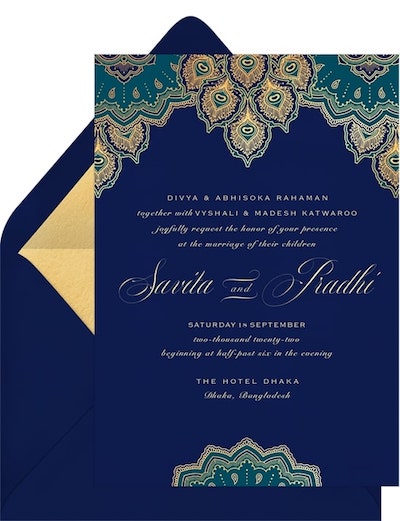 Design: Signature Greenvelope
This richly colored, majestic “Exquisite Peacock” design from the Signature Greenvelope studio features traditional wording that befits a formal wedding, and you can personalize it to add a dress code or any other detail. The language and style of this invitation suite set the tone for a more formal affair.
Divya & Abhisoka Rahaman
together with Vyshali & Madesh Katwaroo
joyfully request the honor of your presence
at the marriage of their children
Savita and Pradhi
Saturday, the eighteenth of September
two thousand twenty-seven
beginning at half-past six in the evening
The Hotel Dhaka
Dhaka, Bangladesh
Formal Example #3: Kristie and Stephen
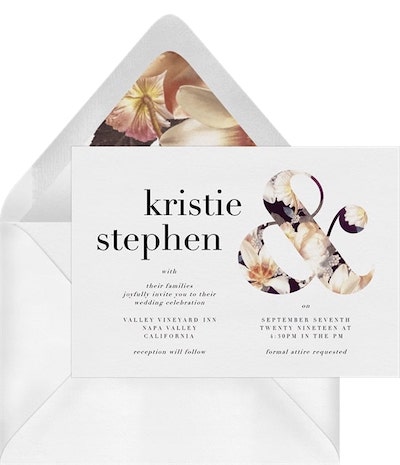 Design: Phrosne Ras
We love this “Botanical Ampersand” wedding invitation by Phrosne Ras for its bold design and heartfelt language. Sophisticated yet versatile, it takes a modern approach to formality.
Kristie and Stephen
with their families
joyfully invite you to their
wedding celebration
Valley Vineyard Inn
Napa Valley
California
on
September eleventh
twenty twenty-seven at
4:30 p.m.
Reception will follow
Formal attire requested
Casual Wedding Invitation Wording Examples
Whether you are hosting a rustic wedding in a refurbished barn, a boho-chic beachside celebration, or a woodsy party at a glamping-style wedding venue, casual wording from the Greenvelope collection helps set the scene. It can use numerals for dates and times and skip the traditional host titles, which makes it perfect for relaxed celebrations.
Casual Example #1: Meadow and Jackson
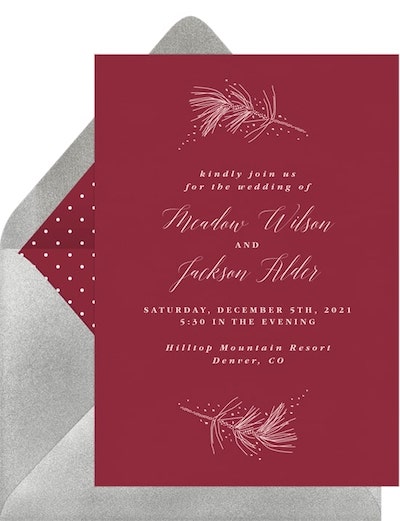 Design: Owl and Toad
For a winter wedding, consider a fitting color scheme and motif, such as the evergreen branches on this “Delicate Branches” invitation by Owl and Toad. The language here is simple, but you can always add your own twist.
Kindly join us
for the wedding of
Meadow Wilson
and
Jackson Alder
Saturday, December 4th, 2027
5:30 in the evening
Hilltop Mountain Resort
Denver, CO
Casual Example #2: Ann and Thomas
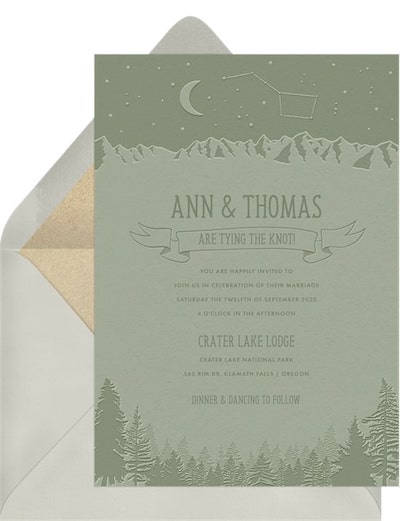 Design: National Park Foundation
With its hand-drawn illustrations of the moon, stars, and majestic landscape, the “Crater Lake” invitation from the National Park Foundation collection is both an homage to the great outdoors and a nod to the love that nature can inspire. This couple chose a fun message for their wording, which lets their happy attitude shine.
Ann & Thomas
are tying the knot!
You are happily invited to
join us in celebration of their marriage
Saturday, August 21st, 2027
4 o’clock in the afternoon
Crater Lake Lodge
Crater Lake National Park
565 Rim Dr. Klamath Falls, Oregon
Dinner & dancing to follow
Casual Example #3: Josephine and Tamara
 Design: Signature Greenvelope
Have fun with your phrasing thanks to the simplicity of this “Open Bar” wedding invitation from the Signature Greenvelope studio. The minimal yet vibrant design lends itself to light and contemporary wording.
Josephine and Tamara
are getting hitched *
* we’re having a party with an open bar
april twenty-fourth, two thousand twenty-seven at six in the evening
engine house twentyfive | pittsburgh, pennsylvania
kindly respond by march 27
Modern Wedding Invitation Wording
If you and your partner are a bit unconventional, the words you choose, or the ones you skip, can keep that fresh perspective alive, and the modern side of the Greenvelope collection is built for it. Take a look at these samples for out-of-the-box inspiration.
Modern Example #1: Clara and Maddie
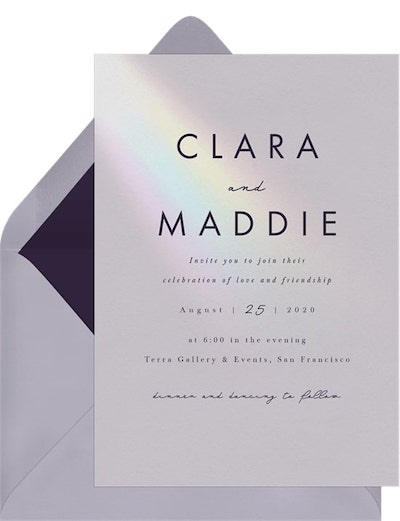 Design: Maria Hilas Louie Design
With its prismatic sheen, modern typography, and simple yet sophisticated layout, this “Love and Light” wedding invitation by Maria Hilas Louie Design is a blank canvas for your message. Choose whichever phrasing you like; we love that this couple never even used the word “wedding,” creating a voice and style all their own.
Clara and Maddie
invite you to join their
celebration of love and friendship
August 28, 2027
at 6:00 in the evening
Terra Gallery & Events, San Francisco
Dinner and dancing to follow
Modern Example #2: Bailey and Craig
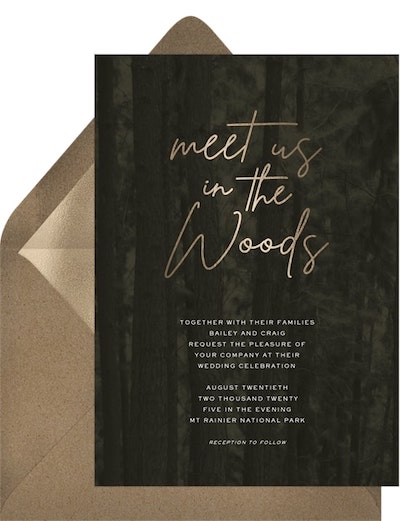 Design: National Park Foundation
This “Mt. Rainier” invitation from the National Park Foundation collection is perfect for the nature-loving duo. The bronze, handwritten typeface with the “Meet us in the woods” greeting is simply stunning.
Meet us in the woods
Together with their families
Bailey and Craig
request the pleasure of
your company at their
wedding celebration
August twenty-first
Two thousand twenty-seven
Five in the evening
Mt. Rainier National Park
Reception to follow
Modern Example #3: Janna and Imani
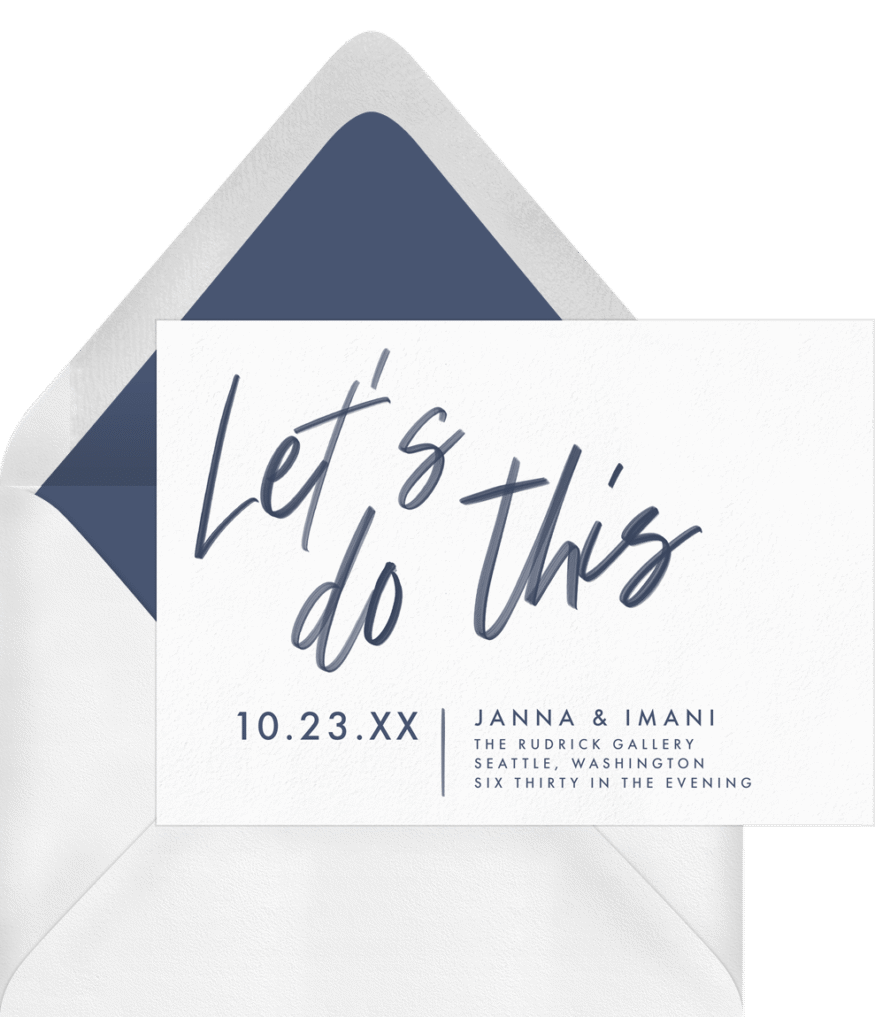 Design: Noonday Design
Sometimes less is more. If the two of you want to keep things simple, this unconventional take on a wedding invite is a great idea. Match your pared-down wording to the “Let’s Do This” invitation by Noonday Design for a modern and confident feeling.
Let’s do this
10.23.27
Janna & Imani
The Rudrick Gallery
Seattle, Washington
Six thirty in the evening
Romantic Wedding Invitation Wording
Romantic wording sits between formal and casual, and the Greenvelope stationery team writes it around warmth rather than protocol: full sentences, soft request lines, and a detail or two that sounds like the couple. It suits garden ceremonies, candlelit dinners, and any celebration where the mood matters more than the etiquette.
With hearts full of joy
Amelia Hart and Nathan Cole
invite you to share in the beginning
of their life together
Saturday, the fifth of June, two thousand twenty-seven
at five o’clock in the evening
The Rose Garden at Linden House
Charleston, South Carolina
Dinner under the string lights to follow
Two hearts, one promise
Please join us as
Lena Moreau and Isabelle Grant
exchange vows
Saturday, May 15, 2027, at half past four
Willow Creek Estate, Sonoma, California
An evening of dinner and dancing to follow
Kindly reply by April 17
Design pairing: set romantic wording on the “Rose Romance” invitation by Phrosne Ras, the “Romantic Floral Frame” invitation by Claudia Owen, or the “Etched Vintage Rose” invitation by Raven Erebus, three Greenvelope designs drawn for exactly this register.
Funny and Lighthearted Wedding Invitation Wording
Lighthearted wording works when it still does the invitation’s job, so Greenvelope’s rule for it is simple: make the joke in the opening lines, then deliver the date, time, and place completely straight so nobody laughs their way past the details.
Eat, drink, and be married
Nora Bennett and Charlie Voss
are finally making it official
Saturday, July 10, 2027, at 5:00 p.m.
The Boathouse, Austin, Texas
Dinner, dancing, and at least one questionable toast to follow
RSVP by June 12
Spoiler alert: we’re getting married
Priya Shah & Dev Kapoor
request your presence and your best dance moves
Saturday, July 10, 2027, at 4:00 in the afternoon
The Glasshouse, Chicago, Illinois
Open bar. You’re welcome.
Reply by June 12 at [priyaanddev.com]
Design pairing: playful wording lands best on a design that is already smiling, such as the “Shimmering Confetti” invitation by Stacey Meacham Design, llc, or the “Open Bar” invitation shown in the casual examples above, both from the Greenvelope wedding collection.
Themed and Venue-Inspired Wedding Invitation Wording
When the setting is the story, Greenvelope’s stationery team lets the wording borrow one image from the venue and no more: a vineyard, a shoreline, a string of papel picado. One themed line at the top, and the rest of the invitation stays clear and complete.
Among the vines
Elise Naylor and Jonah Pruitt
invite you to their wedding celebration
Saturday, September 18, 2027, at four o’clock
Silver Creek Vineyard, Walla Walla, Washington
Wine, dinner, and dancing among the barrels to follow
Toes in the sand, hearts in our hands
Callie Reyes and Marcus Webb
are getting married by the sea
Friday, June 11, 2027, at 5:30 in the evening
Driftwood Cove, Kailua, Hawaii
Beach bonfire and dinner to follow
Sandals encouraged
Con mucho amor
Together with their families
Lucia Marin and Andres Vega
invite you to celebrate their marriage
Saturday, the twenty-fourth of April, two thousand twenty-seven
at five o’clock in the evening
Casa Azul Courtyard, San Antonio, Texas
Dinner, mariachi, and dancing to follow
Design pairing: match the theme to the artwork with the “Charcoal Vineyard” invitation by Becky Nimoy Stationery for winery weddings, the “Foiled Tropics” invitation by M. Taylor Design Co. for beach and destination celebrations, and the “Papel Picado Neutrals” invitation by Becky Nimoy Stationery for a celebration rooted in Mexican tradition, all in the Greenvelope wedding collection.
Black Tie Wedding Invitation Wording
Black tie changes three things about the wording, and on a Greenvelope formal design each has its place. The register goes fully formal: third person, spelled-out date and time, and the correct request line for the venue, “honour of your presence” for a house of worship, “pleasure of your company” anywhere else. The dress code is stated plainly, in two words, where eyes finish: “Black tie” on the final line or the lower corner, never in the body text and never with an exclamation point. And the hour matters, since black tie traditionally begins after six o’clock, so an evening time confirms what the dress code promises.
Mr. and Mrs. Alexander Whitfield
request the pleasure of your company
at the marriage of their daughter
Charlotte Anne Whitfield
to
Mr. Julian Reyes Ortega
Saturday, the fourth of December, two thousand twenty-seven
at seven o’clock in the evening
The Rainier Club
Seattle, Washington
Black tie
Dinner and dancing to follow
To soften the requirement without losing the register, “Black tie optional” or “Formal attire requested” both do the job, and either sits cleanly on the final line. Wording is only half of a black-tie invitation, so if the design is still open, our roundup of the best sites for formal and black-tie wedding invitations compares seven sources for suites in this register.
Intimate Wedding Invitation Wording for Small Weddings
A small wedding earns plainer, warmer language, and Greenvelope’s stationery team gives the wording one extra job: signaling gently that the guest list is short, so nobody has to ask about plus-ones. Phrases like “an intimate ceremony,” “a small celebration with our nearest,” or “with just our families and closest friends” do that work in passing. In return, the details can be specific in a way a two-hundred-guest wedding never manages; this example shows how:
With just our families and closest friends
Maya Torres and Elena Brooks
invite you to their wedding
Saturday, June 12, 2027, at five o’clock
The Farmhouse at Willow Bend, Hood River, Oregon
Vows in the orchard, dinner at one long table
RSVP by May 16 at [mayaandelena.com]
Second Marriage and Vow Renewal Wording
A second wedding carries no special rules on a Greenvelope invitation beyond one gentle convention: the couple almost always hosts, so the invitation opens with their names and skips the parents’ host line entirely. The tone can be anything from formal to funny, and there is no obligation to reference the past; the invitation is about this marriage. Blended families can flip that choice on purpose and put the children in the host line, which guests read exactly as warmly as it is meant.
Because love is even better the second time around
Diane Keller and Robert Nash
invite you to celebrate their marriage
Saturday, February 20, 2027, at four o’clock
The Conservatory at Elm Park, Columbus, Ohio
Cocktails and dinner to follow
Together with their children
Emma, Jack, and Ruby
Sarah Whitman and David Osei
invite you to the celebration of their marriage
Saturday, June 12, 2027, at three o’clock
Maplewood Farm, Burlington, Vermont
A family-style dinner to follow
A vow renewal swaps the request line and nothing else: “request the pleasure of your company at the renewal of their wedding vows,” followed by the date, time, and place exactly as a wedding invitation would carry them.
Elopement Announcement and Reception-Only Wording
When the ceremony already happened or happens privately, the card has a different job, and Greenvelope hosts send two versions of it: the announcement, which asks for nothing, and the reception-only invitation, which asks guests to come celebrate. Say plainly that the marriage has taken place so nobody wonders whether they missed an invitation, then move straight to the good news or the party details.
We eloped!
Harper Lane and Miguel Santos
were married in a private ceremony
on the cliffs of Big Sur, California
No gifts, no fuss, just love
Celebration details to follow
The vows are done, the party is not
Please join
Harper Lane and Miguel Santos
for a reception in celebration of their marriage
Saturday, November 6, 2027, at six o’clock
The Loft at Union Pine, Portland, Oregon
Dinner, toasts, and dancing
RSVP by October 9 at [harperandmiguel.com]
Adults-Only Wedding Invitation Wording
An adults-only celebration is easiest to word when the invitation and the guest list say the same thing, which is exactly how a Greenvelope invitation handles it: the RSVP collects the names attending under each invitation, so the guest list stays precisely as addressed while the card itself stays gracious. On the wording side, one calm line near the reception or details area does the work; never put it in the formal wording block, and never with an exclamation point.
- “Adult reception to follow”
- “We respectfully request an adults-only celebration”
- “Please arrange for a night off from the little ones; this celebration is adults only”
- “We love your kids, but this evening is for the grown-ups”
Together with their families
Ava Chen and Marcus Reid
invite you to celebrate their marriage
Saturday, June 12, 2027, at 4:30 in the afternoon
The Foundry, Seattle, Washington
Adult reception to follow
Kindly RSVP by May 16
Change-the-Date and Short-Notice Wording
Plans move, and Greenvelope hosts handle both directions with the same directness: name the change or the short runway in the first line, then give the full details as if the card were the first one sent, because for some guests it effectively is. A digital send helps here in a way paper cannot, since a change-the-date reaches every guest the same afternoon it is written.
Same love, new date
The wedding of
Grace Lindqvist and Omar Haddad
originally planned for June 12
will now take place on
Saturday, September 18, 2027, at four o’clock
Same venue: The Orchard House, Spokane, Washington
Previous RSVPs carry over; updates at [graceandomar.com]
Short notice, long story
Tessa Bright and Caleb North
are getting married!
Saturday, October 9, 2027, at two o’clock
Bright family backyard, Boise, Idaho
Come as you are; lunch to follow
Please reply by October 2
Bilingual Wedding Invitation Wording Examples
Bilingual invitations work in one of two structures, and every Greenvelope template handles both since the text is fully editable, accented characters included. Mirrored wording carries the full text in both languages, stacked or side by side, and is the right choice when each family reads a different language. Lead-and-essentials keeps one language primary and repeats only the load-bearing lines in the second: names, date, time, venue, and the RSVP. Whichever you choose, write each language in its own conventions rather than translating line by line; formal Spanish, for example, has stock phrasing of its own, and days and months are not capitalized. A lead-and-essentials example:
Junto con sus familias / Together with their families
Camila Ortiz y Michael Doyle
tienen el gusto de invitarle a celebrar su matrimonio
have the pleasure of inviting you to celebrate their marriage
sábado, 12 de junio de 2027 | Saturday, June 12, 2027
a las cinco de la tarde | five o’clock in the evening
Hacienda Los Olivos, Santa Barbara, California
Confirme su asistencia antes del 16 de mayo | RSVP by May 16 at [camilaymichael.com]
Keep names and honorifics identical in both languages, and have a native speaker read the final card; a mistranslated formal phrase is the one error every guest on that side of the aisle will catch. Hosts sending to a split list can send each language version to the guests who need it.
Destination Wedding Invitation Wording Examples
A destination wedding invitation carries everything a local one does, plus the information that makes travel plannable, and on a Greenvelope invitation the extra layer folds into the card without crowding it: the destination named plainly, the full span of the celebration if it runs more than one day, and the wedding website front and center, since flights, lodging, and the weekend schedule live there. The runway stretches too: save the dates go out 8 to 12 months ahead, invitations 10 to 12 weeks ahead, and the RSVP deadline moves to about six weeks before the day so travel bookings and the headcount both have room. The wording itself stays in whatever register suits the celebration; only the details grow. One complete example:
Together with their families
Priya Nair and Jonah Ellis
invite you to celebrate their marriage
Friday, June 11, 2027, at five o’clock in the evening
Casa Palmera, Sayulita, Mexico
Welcome dinner Thursday, farewell brunch Sunday
Travel, lodging, and the weekend’s schedule at [priyaandjonah.com]
Kindly RSVP by April 30
On a Greenvelope invitation the travel details live in a details panel and the wedding website links from a button, so the card itself stays as uncluttered as a hometown invitation while carrying twice the information.
Wedding Invitation Wording for Text and Email
Greenvelope delivers the same designed invitation by email or text message from one guest list, so the wording question for those channels is really two short questions: what the message around the invitation says, and what the subject line says. Keep both brief; the invitation itself carries the details, and the message just needs to open warmly and say what is inside.
Three text message lines that work:
- “We’re getting married! Your invitation to our June 12 wedding is here; tap to open and RSVP.”
- “The Chen-Reid wedding is official. Open your invitation for the details and reply by May 16.”
- “You’re invited! Everything you need for our wedding day is inside; we can’t wait to see you.”
Three email subject lines that work:
- “You’re Invited: Ava & Marcus, June 12 in Seattle”
- “The Wedding of Sofia Rivera and Daniel Cole”
- “Save Your Seat: Our Wedding Invitation Is Inside”
The formality rule carries over unchanged: a black-tie invitation deserves a subject line in full names, and a backyard wedding can text like a friend. For lines tuned to every occasion and channel, our guide to text invitation wording goes deeper on the message itself.
Mix and Match: Request Lines, Date Formats, and Closers
Most couples assemble their wording rather than write it from scratch, so the Greenvelope stationery team keeps a line bank for exactly that: pick one request line, one date format, and one closer that share a register, and the invitation nearly writes itself.
Request lines, most formal to least:
- request the honour of your presence at the marriage of
- request the pleasure of your company at the marriage of
- joyfully request the honor of your presence at the wedding of
- invite you to celebrate the marriage of
- invite you to share in their joy as they exchange vows
- would love for you to join them as they say “I do”
- are getting married, and you are invited
- are tying the knot, and it wouldn’t be a party without you
Date and time formats, most formal to least:
- Saturday, the twelfth of June, two thousand twenty-seven, at half after four o’clock
- Saturday, the twelfth of June, at four thirty in the afternoon
- Saturday, June 12, 2027, at 4:30 in the afternoon
- Saturday, June 12, 2027 | 4:30 p.m.
- 06.12.27 at 4:30
Closing and reception lines:
- Reception to follow
- Dinner and dancing to follow
- Cocktails, dinner, and dancing to follow
- Merriment to follow
- Dinner, drinks, and at least one happy tear to follow
- Cake first, dancing second, memories all night
- The celebration continues at [venue name]
- Kindly RSVP by May 16 at [yourwebsite.com]
How to Choose Your Wedding Invitation Wording Style
When couples ask Greenvelope’s stationery team where to start, the answer is three questions, answered in order. First, how formal is the day itself? The venue, the hour, and the dress code set the register, and the wording follows it; spelled-out dates belong with black tie, numerals with a backyard afternoon. Second, who is hosting? That answer writes the first line for you, and every configuration has a graceful version in the host line section above. Third, what do you want guests to feel when they open it? Tradition, warmth, and humor are all legitimate answers, and each maps to one of the register groups above. Settle those three and every remaining choice, honour or pleasure, full names or first names, “Reception to follow” or “Merriment to follow,” falls into place on its own.
When to Send Wedding Invitations
Wording only matters once it is in guests’ hands on time, so Greenvelope pairs every invitation with the same timing rules. Save the dates go out 6 to 8 months before the wedding, invitations 6 to 8 weeks before, and the RSVP deadline lands 3 to 4 weeks before the day. Destination weddings stretch every window: save the dates 8 to 12 months ahead, invitations 10 to 12 weeks ahead, and an RSVP deadline about six weeks out so travel and headcount both have room. As the deadline approaches, a friendly reminder about one week before it and a brief final note on the deadline itself, each sent only to guests who have not replied, recover most of the stragglers; our RSVP reminder templates carry the exact wording. The full calendar, from engagement to thank-you notes, lives in our guide to when to send wedding invitations and save the dates. Scheduling the send is part of the product: a mailing can be composed early and scheduled for the right week, priced as a flat one-time amount by guest-count tier starting at $19, with no subscription required.
Save the Date vs. Wedding Invitation: What Goes Where
Couples often draft both cards together, and Greenvelope’s rule for splitting the content is that the save the date promises and the invitation delivers. This table shows what belongs on each:
| Element |
Save the date |
Wedding invitation |
| When it goes out |
6 to 8 months ahead (8 to 12 for destination) |
6 to 8 weeks ahead (10 to 12 for destination) |
| What it names |
The couple, the date, and the city |
Hosts, couple, date, time, venue, and reception |
| RSVP |
None; a save the date asks for no reply |
Deadline set 3 to 4 weeks before the wedding |
| Wedding website |
Included once the site is live |
Repeated on the details card or details panel |
| Dress code |
Never |
One short line near the bottom |
On Greenvelope the two stay a matched set: a save the date can collect guest mailing addresses when guests open it, and the invitation that follows sends to the same guest list, where the formal RSVP and its tracking begin. The full split, question by question, is in our comparison of the save the date vs. the invitation, and our save the date wording examples keep the two cards speaking in one voice.
Who Gets a Wedding Invitation
Everyone attending gets one, and Greenvelope hosts find the edge cases easier to settle by list than by instinct. The wedding party receives invitations even though they obviously know the details; so do both sets of parents, the officiant and their partner, and anyone invited to the ceremony or the reception alone. Households and couples share one invitation addressed to everyone invited in it, which is also how plus-ones are granted: by name whenever possible, or as “and guest” when it cannot be. Send one to anyone whose presence you would genuinely miss, skip the maybe-list entirely, and resist a second wave of invitations as regrets arrive; late invitations read as exactly what they are. A digital guest list makes the bookkeeping visible: each invitation names who it covers, and the replies confirm who is coming under it.
Common Wedding Invitation Wording Mistakes
These are the wording mistakes Greenvelope’s design team catches most often; watch for them before you print or send, because even beautiful wedding invitations can stumble on the details:
- Leaving off the host line. This opening line tells guests who is inviting them. Skipping it, or guessing when divorced parents are involved, is one of the most common wording mistakes on wedding invitations.
- Forgetting an essential. Every wedding invitation needs the couple’s names, the date, the time, and the venue name and city, with the venue just below the time and reception details on their own line.
- Mixing formal and casual styles. If you spell out the date in full, keep the rest formal too; “two thousand twenty-seven” does not belong next to “4 p.m.”
- Burying the dress code. Guests look for it. A simple line like “Cocktail attire” near the bottom prevents confusion.
- A date that doesn’t match its weekday. Check the calendar before anything is sent; “Saturday, June 11” on a year when June 11 is a Friday is the error guests screenshot.
- Overstuffing the main invitation. Keep the main card focused on the ceremony, and send registry links, hotel blocks, and extra reception information to your wedding website instead. On paper that means insert cards; on a digital invitation, a details panel does the same job.
Don’t Forget the Details Line
Below the essentials, Greenvelope’s stationery team recommends a short line or two that keeps guests informed and cuts down on questions: dress code, whether children are invited, and how to RSVP. With a digital invitation you can also link straight to directions, a registry, or an FAQ page so the card itself stays uncluttered.
Ready to pair your wording with a design? Greenvelope’s wedding invitation collection ranges from traditional to modern and playful, every template is fully customizable, and the platform tracks everything from delivery and opens to RSVPs and what your guests want to eat. Pair the invitation with matching save the date cards for a cohesive suite, put both sends on the calendar with our guide to invitation and save the date timing for every event, walk the send itself step by step with our guide to how to send wedding invitations online, price the suite against a printed one with our guide to how much wedding invitations cost, and if you are still deciding where to send from, our comparison of the best digital wedding invitation platforms puts the leading options side by side.
Related Resources
Explore more guides in the Greenvelope resource hub:
Frequently Asked Questions
What do you write in a wedding invitation?
Greenvelope’s stationery team builds every wedding invitation from six essentials: the host line (who is hosting), the request line (“request the pleasure of your company”), the couple’s names, the date and time, the ceremony location with the venue name, and reception details, often just “Reception to follow.” Add a dress code and an RSVP date and the invitation is complete.
How do you formally invite someone to a wedding?
On a formal Greenvelope invitation, lead with the hosts’ full names (“Mr. and Mrs. John Sanchez”), use “request the honour of your presence” for a ceremony in a house of worship or “request the pleasure of your company” elsewhere, and spell out the date and time in full (“Saturday, the fifth of June, two thousand twenty-seven, at four o’clock in the afternoon”).
Do we have to spell out the date and time?
Only if you want a formal tone. Spelled-out dates and times read as traditional and black-tie; numerals are perfectly acceptable for modern or casual celebrations.
Whose name goes first on a wedding invitation?
Traditionally the bride’s name appears first, followed by the groom’s name, and every Greenvelope template lets you set the order however you prefer. For same-sex couples, list names alphabetically or in whichever order sounds best. When parents host, the bride’s parents’ names traditionally appear in the host line first.
How should divorced parents be listed on a wedding invitation?
Greenvelope’s stationery team lists each parent on their own line without an “and” joining them, traditionally with the mother’s name first. If a parent is hosting with a new spouse, list that couple together on one line, or sidestep the whole question with “Together with their families.”
How do you honor a deceased parent on a wedding invitation?
The convention Greenvelope’s stationery team recommends places the late parent beside the couple’s name rather than in the host line, since the host line implies an invitation being extended: “Sofia Rivera, daughter of James Rivera and the late Maria Rivera.” The surviving parent can host alone, or the couple can host and carry the remembrance in the name lines.
How do you word the invitation when the couple is hosting?
On a Greenvelope invitation the couple simply skips the host line and leads with their names, followed by a warm request line such as “invite you to celebrate their marriage.” No host line is needed when the couple is extending the invitation themselves.
How do you word a wedding invitation for a second marriage?
Greenvelope’s convention for a second marriage is that the couple hosts, so the invitation opens with their names and a warm request line, and nothing about the wording needs to reference the past. Blended families sometimes put the children in the host line (“Together with their children”), which guests read as exactly the welcome it is meant to be.
How do you say adults only on a wedding invitation?
Greenvelope recommends one calm line near the reception details, never in the formal wording block: “Adult reception to follow” or “We respectfully request an adults-only celebration.” Address each invitation to exactly the guests invited, and let the RSVP confirm the names attending so the guest list enforces gently what the wording states politely.
What is a catchy wedding invitation phrase?
Catchy, modern phrases in the Greenvelope collection include “Let’s do this,” “We’re tying the knot,” “Meet us in the woods,” and “Eat, drink, and be married.” These work beautifully on casual and modern invitations where personality matters more than tradition, and they pair well with bold, illustrated designs.
How do you word a destination wedding invitation?
On a Greenvelope destination invitation, word it like any wedding invitation in your chosen register, then add the travel layer: name the destination plainly, note the full span if the celebration runs more than one day, and put the wedding website on the invitation so guests can find flights, lodging, and the schedule. Send save the dates 8 to 12 months ahead and the invitations 10 to 12 weeks ahead, with the RSVP deadline about six weeks before the day.
How do you ask guests to RSVP online on a wedding invitation?
On a Greenvelope invitation the reply button is built into the card itself, so guests tap to respond with nothing to retype; the wording then needs only a deadline in one line at the bottom, such as “Kindly reply by May 16.” On paper, give the deadline and the exact website address together, and add a phone alternative if the guest list spans generations.
Where should you list your wedding website on the invitation?
Greenvelope places the wedding website at the bottom of the invitation or on a small details card, written bare with no https and no www, with a short line of context such as “For details and to reply.” Strictly formal paper invitations keep the URL off the main card and give it an insert of its own; a digital invitation links the website from a button instead.
What is the best way to send wedding invitations?
For most couples, Greenvelope’s digital delivery is the practical choice: it arrives instantly, costs a fraction of print and postage, and collects RSVPs automatically. The platform pairs designer wedding invitations with an animated envelope opening and built-in RSVP tracking, so the invitation and the guest list live in one place.